About
About this edition
Annus Mirabilis is an edition, in preparation, of the four papers Albert Einstein sent to the Annalen der Physik in 1905, with his doctoral dissertation beside them. Each paper is explained at the depth you choose, and its instruments work out what follows when you change an assumption.
It is not a biography of Einstein. It has no accounts and no advertising, and no language model runs while you read.
Four papers, or five
Four papers reached the Annalen der Physik in 1905, received on 18 March, 11 May, 30 June and 27 September, and all four were printed that year. A fifth piece of work comes from the same months. Einstein dated his doctoral dissertation, Eine neue Bestimmung der Moleküldimensionen, in Bern on 30 April 1905 and submitted it at Zürich on 20 July. The Annalen printed it in January 1906, and he published a correction to it in 1911.
Einstein counted differently. In May 1905 he wrote to his friend Conrad Habicht and promised him four papers. By his description, the first was about radiation and the energy of light. The second worked out the true size of atoms from how dilute solutions diffuse and how viscous they are; it became his dissertation. The third showed that on the molecular theory of heat, particles about a thousandth of a millimetre across, suspended in a liquid, must move about in a way you can see. The fourth, still a rough draft, was an electrodynamics of moving bodies that changed the theory of space and time. The paper on mass and energy was not among them: it was written later, and the Annalen received it on 27 September.
So Einstein’s four include the dissertation, and the four usually counted now put the mass and energy paper in its place. This edition reads those four in full and keeps the dissertation and its correction beside them as a companion.
The letter is paraphrased here, not quoted: Einstein to Conrad Habicht, May 1905, in The Collected Papers of Albert Einstein, volume 5.
Who makes it
The edition is made by Jeffrey Emanuel, who directs the work and decides what it publishes. Since the work began on 14 September 2026, its explanations and code have been drafted by AI models working under his direction. Where the repository’s record of a change names the model that drafted it, that model is Anthropic’s Claude (Opus 5.5, Opus 5 or Sonnet 5) or xAI’s Grok.
No one else has yet reviewed the German, the explanations or the physics. A reviewer will be named here, with their consent, once they have checked something.
How it is made
Every page image is cut from a scan whose source, terms and digest are listed on Sources, with how far each transcription has got.
The German text is read by machine from each scan and corrected by hand against its page images, and it stays a draft until a second reader has checked it against the page. The source is kept as printed: a suspected misprint is recorded beside it, never corrected in it.
The explanations are new writing in modern notation, drafted with AI assistance, and each is marked as awaiting review until it has been checked. You choose how much of each you read: an overview, the full explanation, or every step, and you can add a modern lens on what came later. The discovery journeys reconstruct a way to a result from what was known before 1905, and say so: each is a route you could take, not a record of what Einstein thought.
Every number an instrument shows is worked out by that instrument and labelled as a calculation. None of them is a measurement of nature.
The English translation is the edition’s own, made from the German. The English translation has begun with the mass and energy paper: 43 passages, all drafted by a machine, and none reviewed yet. Published translations are used only to compare readings against, as Sources explains.
License
Einstein’s German text is in the public domain. Each scan carries its host’s terms, listed on Sources. Everything written for this edition, the explanations, the code and in time the translation, is under the MIT License with the OpenAI/Anthropic Rider, as decided on 16 September 2026. The fonts are under the SIL Open Font License. The notice gives the terms for each layer.
How to cite it
When you quote or reuse something from this edition, the license asks for this line:
Annus Mirabilis (annus-mirabilis.com), critical edition and translation by Jeffrey Emanuel and contributors, based on Albert Einstein (1905).
A citation should also say which version you read, because the explanations change as they are revised. Each paper’s explanation has a content revision, a digest of its compiled text, and the edition as a whole has one too. These are the revisions of the pages you are reading now:
- The edition
4ddc12466783- Light quanta
63118d6ea4a5- Brownian motion
7968b89de7fc- Special relativity
7526d2f2ce10- Mass and energy
15a54bb22633- The translation
- The English translation has begun with the mass and energy paper: 43 passages, all drafted by a machine, and none reviewed yet.
So a citation takes one of these forms, with the date you read it:
- The edition: Annus Mirabilis, annus-mirabilis.com, edition revision 4ddc12466783.
- A paper: Annus Mirabilis, “Brownian motion”, annus-mirabilis.com/papers/brownian-motion/, content revision 7968b89de7fc.
- A section or an argument: the paper’s citation, with the address of the part you mean, such as /papers/brownian-motion/#s0 for a section or /papers/brownian-motion/#arg-bm-introduction for one argument in it.
- An instrument: its address, such as annus-mirabilis.com/lab/bm-01/, with the edition revision and the settings you used. A link cannot yet carry the settings, and an equation cannot yet be linked on its own.
To cite Einstein’s papers themselves, use their Annalen der Physik references, which Sources gives for each.
What you may take away
The attribution above is how to credit the edition. It does not grant anything, and it does not cover what the edition did not make. What you may reuse is recorded with each thing you can download:
- All six scans. Published here. Reuse is governed by its host's own terms, as recorded. Recorded as: Internet Archive Terms of Service and open access collection metadata. Read the terms as they stood on 18 September 2026.
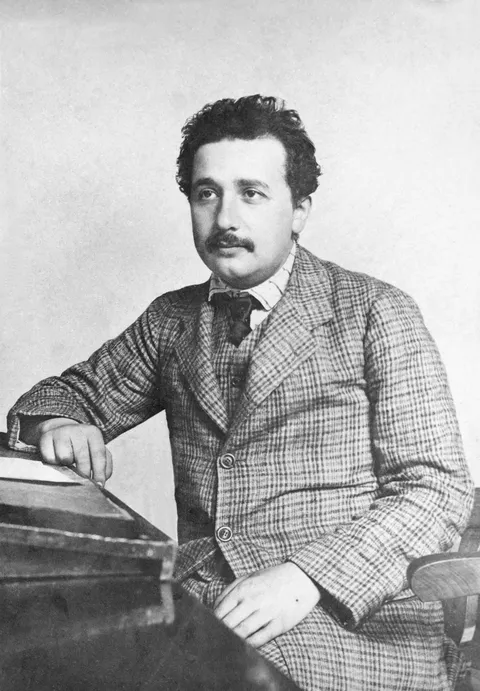
- The photograph above. ETH-Bibliothek Zürich, Bildarchiv marks it with the Public Domain Mark; see its record.
Reporting a mistake
If you find a mistake in the German, an explanation or a number, or something on a page you cannot reach or use, please open an issue in the repository. Say which page and which passage, and what you expected to find.
A suspected misprint in the German is checked against the page image before it is recorded, and the printed reading is kept beside it. A correction that turns out to be wrong is withdrawn, not deleted, and keeps its reason; each paper’s receipt on Sources counts both kinds.
Accessibility
The site aims to meet the Web Content Accessibility Guidelines 2.2 at level AA, and does not yet claim to. Accessibility says what has been checked, how, and what has not.
Testing with readers
No round of testing with readers has been held yet. When one has, this section will list the routes tested, when, and the barriers found. It will not report scores: a small round finds problems, and it cannot measure how well the site teaches.
What it keeps about you
The site sets no cookies, loads nothing from any other site, and runs no analytics. What you save stays on your device: reading preferences, notes and predictions are kept in your browser, and What this site stores shows them, lets you download them, and lets you clear them.
The pages are served by Vercel. As with any web host, its servers receive the address and request of each visitor, and what Vercel keeps is set by its own privacy policy.