A route you could take
Discovery routes
Each route puts you where a careful reader stood at the end of 1904: holding the results already in print, facing an observation that does not fit them, and not yet knowing which way the answer lies. You make each move yourself, and the paper comes at the end, at the passage where it makes the same move.
A route is one way to reach the argument from what was known at the time. Each says at its start that it is a reconstruction, and none claims to be how Einstein thought.
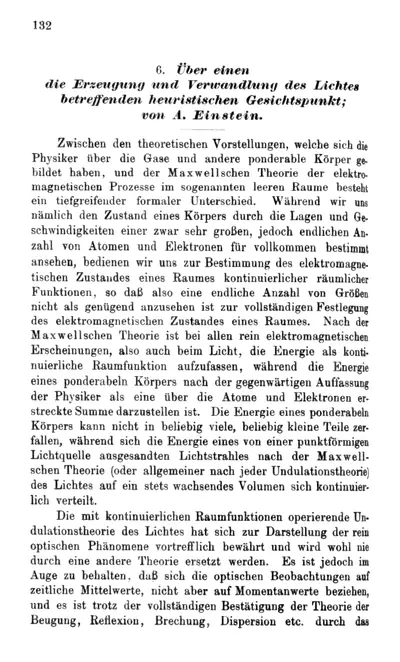
17 pages, pp. 132–148
Received 18 March 1905
Über einen die Erzeugung und Verwandlung des Lichtes betreffenden heuristischen Gesichtspunkt
Light quanta
The wave theory was not in trouble in 1904, and this route keeps every one of its successes. Optical experiments measure averages over time; the route looks at what they never reached, the moment light is emitted or absorbed. Eight steps, nine instruments, and nothing on the shelf from after 1904.
- Start with what works
- Find the edge of the evidence
- Make a prediction
- Work where a law is solid
- Do the same sum for something you understand
- Compare the two, and read the exponent
- Demand consequences
- Check it against the world
Where this enters the paper
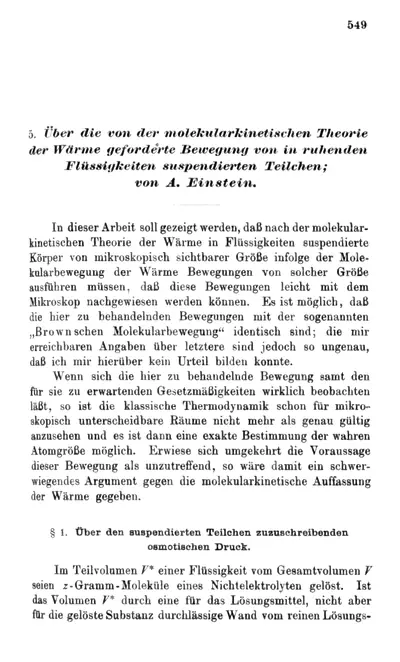
12 pages, pp. 549–560
Received 11 May 1905
Über die von der molekularkinetischen Theorie der Wärme geforderte Bewegung von in ruhenden Flüssigkeiten suspendierten Teilchen
Brownian motion
Particles from inside pollen grains, suspended in still water, never come to rest. The route asks whether a particle you can see presses like a dissolved molecule, and what you would measure to decide whether molecules are shoving it. A particle’s apparent speed depends on how often you look, so the route works with how far it gets in a given time. Eight steps, seven instruments, and the 1904 shelf of results you may use.
- Choose a quantity
- Ask whether it presses
- Balance a force against drag
- Make a prediction
- Ask an interval question
- Check it against the world
- Turn the question around
- Try it yourself
Where this enters the paper
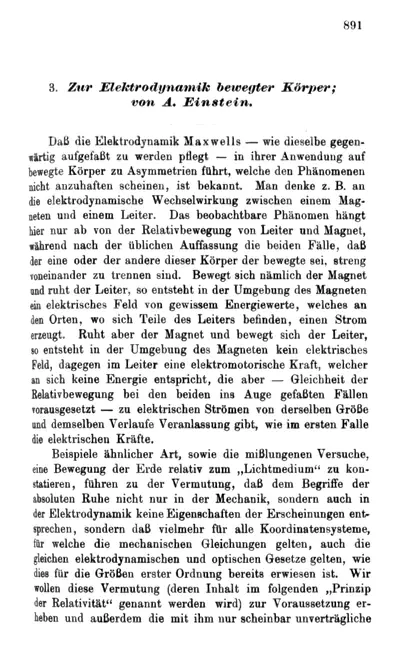
31 pages, pp. 891–921
Received 30 June 1905
Zur Elektrodynamik bewegter Körper
Special relativity
A magnet, a coil, and a needle that moves. Move the magnet or move the coil and the needle shows the same current, but the electrodynamics of 1904 explains the two cases in two different ways. Following that through means giving up the idea that “at the same time” needs no definition. Eight steps, eight instruments, and Lorentz’s theory, which gives the same formulas, on the shelf beside it.
- Start where the paper starts
- Decide whether that bothers you
- Make a prediction
- Find the assumption
- Build the map
- Read off the consequences
- Meet the serious rival
- Check it against the world
Where this enters the paper
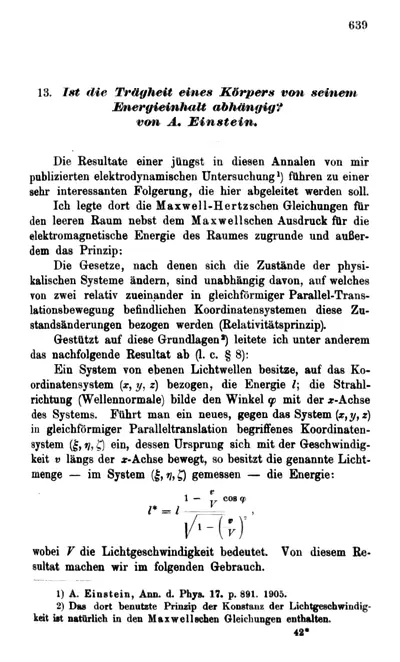
3 pages, pp. 639–641
Received 27 September 1905
Ist die Trägheit eines Körpers von seinem Energieinhalt abhängig?
Mass and energy
A body at rest sends out two equal flashes of light in opposite directions, so it stays where it is. Energy has left it and nothing you can see about it has changed, so the route asks what did. Seven steps, with a prediction to make before you read the answer, a number to check against the world, and four pieces to work by hand. One result is borrowed from the June relativity paper, how the energy of light depends on the frame, and the route names it where it is used.
- Start with a body that does nothing
- Make a prediction
- Describe the same event twice
- Subtract
- Read the coefficient
- Check it against the world
- Try it yourself
Where this enters the paper