The corpus
The four papers of 1905
Four papers, sent to Annalen der Physik between March and September, in the order the journal received them. The last of them is a three-page consequence of the third, so the order is worth keeping. It is the only order here: nothing on this page ranks them, and the printed extent beside each one is a fact about the paper rather than a suggestion about you.
What a paper is here
Every one of the four opens on the same set of faces, and a face is a way of showing the same passage rather than a different document. The names below are the ones the reader controls use; switching between them keeps your place at the same sentence.
- German source
- The paper as printed, in Einstein's German, with the page turns marked where they fall.
- English translation
- A close English rendering, sentence by sentence against the German.
- Interlinear gloss
- Word for word under the German, for a reader following the original with little German.
- Parallel bilingual
- The two side by side, so a phrase can be checked against its source without leaving the line.
- Explanation
- The explanation: what the passage claims, why the move is allowed, and what it costs.
- Results
- The numbered results on their own, each with the instrument that puts it to work.
- Facsimile
- The scanned page itself, pinned by checksum to the volume it came from.
Behind them sit the instruments, one per claim worth interrogating, and a reconstruction of the problem before its solution was known. Both are reached from the passage they belong to rather than from a menu.
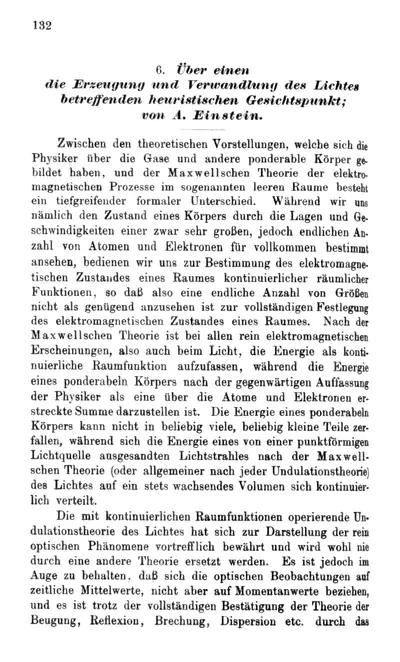
17 pages, pp. 132–148
Received 18 March 1905 · published 9 June 1905
Über einen die Erzeugung und Verwandlung des Lichtes betreffenden heuristischen Gesichtspunkt
On a Heuristic Point of View Concerning the Production and Transformation of Light
Light behaves, in how it is produced and absorbed, as though its energy sits in separate pieces. Einstein calls this a heuristic viewpoint in the title itself, and says where he thinks the wave description stops being the useful one.
Also known as: Light quanta.
Annalen der Physik (4) 17, 132–148 (1905)
It opens on a question: How often can everything end up in the left part?
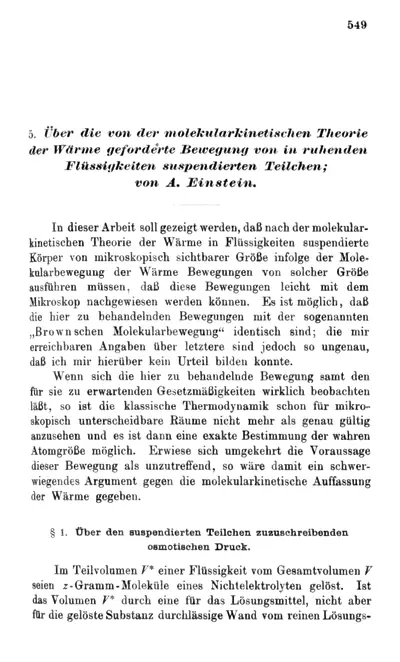
12 pages, pp. 549–560
Received 11 May 1905 · published 18 July 1905
Über die von der molekularkinetischen Theorie der Wärme geforderte Bewegung von in ruhenden Flüssigkeiten suspendierten Teilchen
On the Motion of Small Particles Suspended in Liquids at Rest, as Required by the Molecular-Kinetic Theory of Heat
Editorial: this working title adds a word to the German
"Small": Names the scale of the particles for a reader who has not yet met the term "Brownian motion", before the argument itself establishes why size matters.
If heat is the motion of molecules, a particle visible under a microscope and suspended in a liquid at rest should never stop moving. Einstein works out how far it should wander in a given time: a number a laboratory can check.
Also known as: Brownian motion.
Annalen der Physik (4) 17, 549–560 (1905)
It opens on a question: Do particles that wander in all directions ever get anywhere?
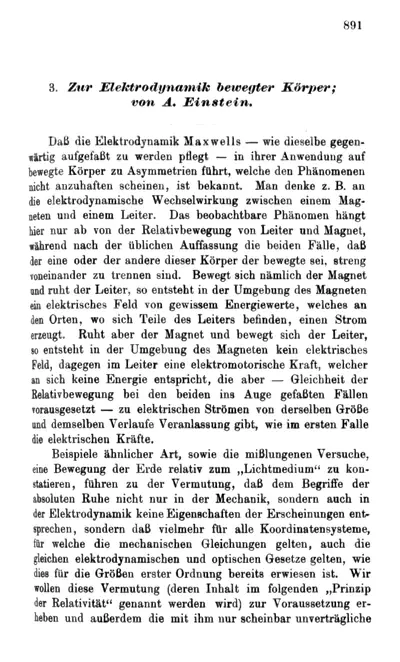
31 pages, pp. 891–921
Received 30 June 1905 · published 26 September 1905
Zur Elektrodynamik bewegter Körper
On the Electrodynamics of Moving Bodies
Move a magnet past a coil, or the coil past the magnet, and you measure the same current; the textbook account of the day told two different stories. Einstein rebuilds the measurement of time around that mismatch, beginning with what it takes to set two distant clocks.
Also known as: Special relativity.
Annalen der Physik (4) 17, 891–921 (1905)
It opens on a question: What should the distant clock read when the flash reflects?
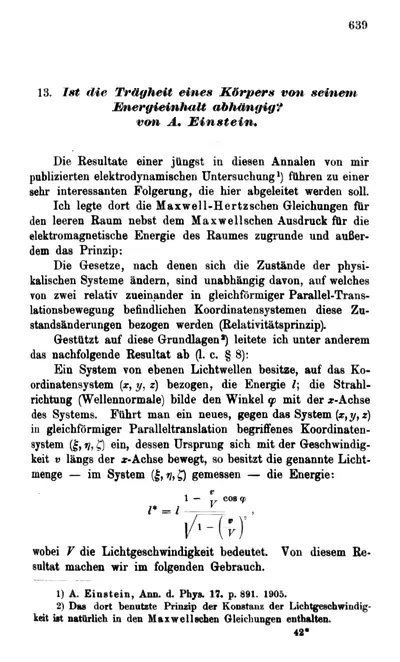
3 pages, pp. 639–641
Received 27 September 1905 · published 21 November 1905
Ist die Trägheit eines Körpers von seinem Energieinhalt abhängig?
Does the Inertia of a Body Depend upon its Energy-Content?
Three pages that follow from the June paper. One body's energy is written down twice, from rest and from a frame gliding past, and the two accounts are subtracted. A body that gives off energy has less mass afterwards.
Also known as: Mass and energy.
Annalen der Physik (4) 18, 639–641 (1905)
It opens on a question: Can a body lose energy of motion without changing speed?
The molecular-dimensions companion
Einstein’s doctoral dissertation, Eine neue Bestimmung der Moleküldimensionen, belongs beside the Brownian paper: it gets at the same molecular quantities by a different route. It is a planned companion record and there is nothing to read here yet.