Keep every explanation and worked example on the page. Nothing moves or plays by itself, and the larger instruments load only when you ask.
Annalen der Physik, 1905
Four papers, 1905
The four papers Albert Einstein sent to the Annalen der Physik in 1905, each explained at the depth you choose, with instruments that work out what follows when you change an assumption.
Light quantaBrownian motionSpecial relativityMass and energy
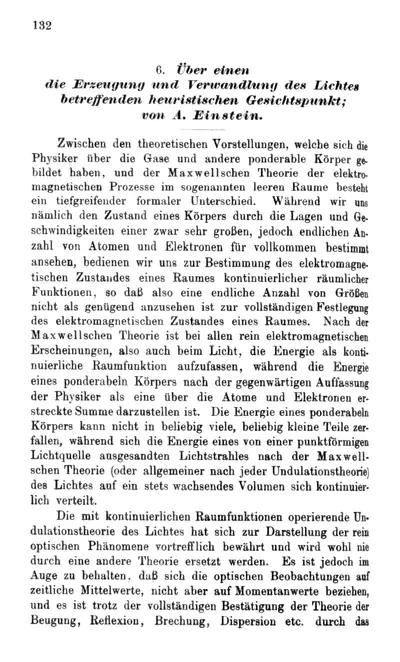
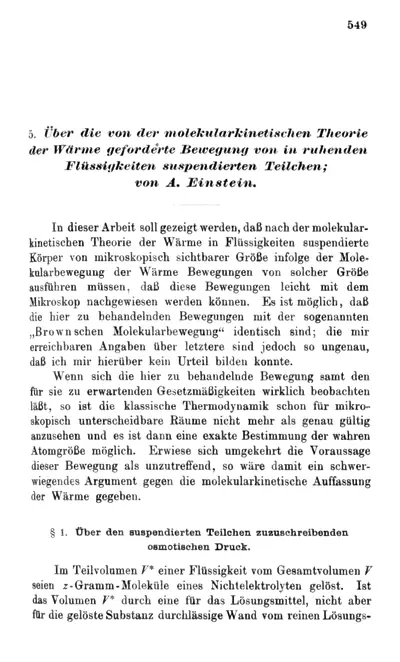
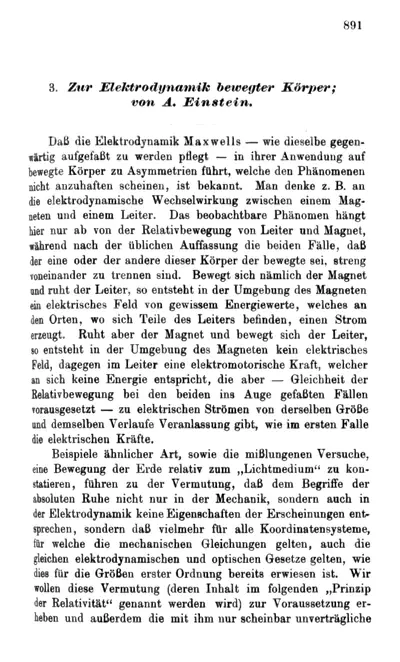
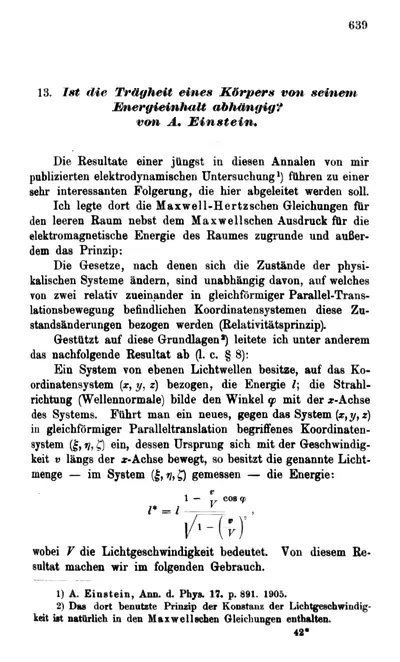
Each paper’s first page as printed, dated by the day the journal received it: 63 printed pages in all. The German text is set for four of the four. The English translation covers the light quanta, Brownian motion, special relativity and mass and energy papers. Scans: Bell & Howell / UMI microfilm, via the Internet Archive.
Each of them unsettled something that had looked settled: how light carries its energy, whether molecules are real, what it means for two events to happen at once, and where a body’s mass goes when it gives off light.
Über einen die Erzeugung und Verwandlung des Lichtes betreffenden heuristischen Gesichtspunkt
Einstein offers what his own title calls a heuristic viewpoint: in how light is produced and absorbed, its energy behaves as though it sits in separate pieces rather than spreading continuously. He does not claim the wave theory is wrong. It keeps everything it had already explained about interference and diffraction, and he says exactly where he thinks it stops being the useful description.
Über die von der molekularkinetischen Theorie der Wärme geforderte Bewegung von in ruhenden Flüssigkeiten suspendierten Teilchen
If heat really is molecular motion, then a particle small enough to see under a microscope has to be knocked about hard enough to watch. Einstein works out how far it should wander, and turns that into a number a laboratory can check. He adds that this may be the motion already named after Brown, but that the reports available to him were too imprecise to say. He also names the stake: if the wandering is not there, the molecular account of heat is in serious trouble.
The paper opens with a magnet and a coil of wire. Move either one and you measure the same current, yet the textbook account of 1905 told two quite different stories depending on which was said to be moving. Einstein takes that mismatch seriously enough to rebuild the measurement of time around it, starting from what it actually takes to set two distant clocks and agree that they read alike.
Ist die Trägheit eines Körpers von seinem Energieinhalt abhängig?
Three pages, and the title is a question rather than a claim. Einstein writes down the energy of one body twice, once from rest and once from a frame gliding past, lets it give off light in both accounts, and subtracts. What survives the subtraction is that the body has less mass afterwards, by the energy it shed divided by the square of the speed of light.
You can read a paper, the German beside a close English translation, and open any paragraph further where you want more of it. You can work an argument out first, on a route that puts the alternatives a careful reader had in 1904 on the table and says which of them still work. Or you can operate the instrument that tests a claim and watch what changes when you change an assumption. The same passages, the same instruments and the same claims are reachable from all three.
Depth is a separate choice from any of that, and it is yours at every paragraph rather than declared once: every reading page carries a Detail control set to Overview, Full explanation or Show every step. Choosing the shortest never hides the source text and never simplifies a later page.
The fourth paper runs to three pages and comes down to one line, in the notation it was set in:
K0−K1=V2L2v2
L is the energy the body has just given off, V is the speed of light, and K0 − K1 is the kinetic energy it has lost in doing so. Set that beside the schoolroom’s ½mv2 and the quantity L/V2 is sitting exactly where a mass belongs. That is the argument. The formula everyone can recite is not on the page: this paper never writes it.
Ann. Phys. (4) 18, 639–641 (1905), p. 641, received 27 September. Transcribed here from the pinned facsimile; all three pages are set.
Where this edition has got to
The explanations, the instruments and the discovery routes are written and working. The German text is set for the light quanta, Brownian motion, special relativity and mass and energy papers.
The English translation covers the light quanta, Brownian motion, special relativity and mass and energy papers.
The page images come from scans listed, each with its source, its terms and its digest, on the sources page. The edition counts four papers and keeps Einstein’s dissertation beside them; About says why.