Quelle
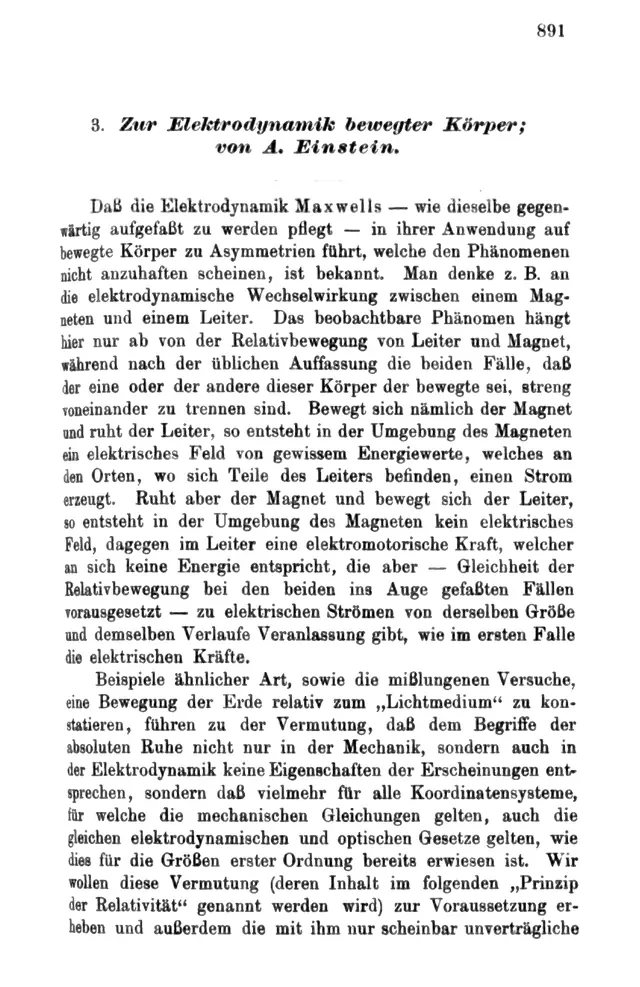
Zur Elektrodynamik bewegter Körper
Bern, Juni 1905.
Annalen der Physik (4) 17, 891–921 (1905).
[p. 892]I. Kinematischer Teil.
[p. 907]II. Eektrodynamischer Teil.
[p. 910]Im Systeme befinde sich sehr ferne vom Koordinatenursprung eine Quelle elektrodynamischer Wellen, welche in einem den Koordinatenursprung enthaltenden Raumteil mit genügender Annäherung durch die Gleichungen dargestellt sei:Electric field, stationary systemElectric field amplitude (stationary system)Wave phaseMagnetic field, stationary systemMagnetic field amplitude (stationary system)Electric field, stationary systemElectric field amplitude (stationary system)Magnetic field, stationary systemMagnetic field amplitude (stationary system)Wave angular frequency (stationary system)Time in the stationary systemDirection cosine (stationary system)Position in the stationary systemDirection cosine (stationary system)Position in the stationary systemDirection cosine (stationary system)Position in the stationary systemSpeed of lightElectric field, stationary systemElectric field amplitude (stationary system)Magnetic field, stationary systemMagnetic field amplitude (stationary system)Explain this equation Hierbei sind und die Vektoren, welche die Amplitude des Wellenzuges bestimmen, , , die Richtungskosinus der Wellennormalen.
Explained in One phase fixes frequency and direction
[pp. 910–911]Wir fragen nach der Beschaffenheit dieser Wellen, wenn dieselben von einem in dem bewegten System ruhenden Beobachter untersucht werden. — Durch Anwendung der in § 6 gefundenen Transformationsgleichungen für die elektrischen und magnetischen Kräfte und der in § 3 gefundenen Transformationsgleichungen für die Koordinaten und die Zeit erhalten wir unmittelbar:Electric field, moving systemElectric field amplitude (stationary system)Wave phaseMagnetic field, moving systemMagnetic field amplitude (stationary system)Electric field, moving systemLorentz factorElectric field amplitude (stationary system)Speed of the moving systemSpeed of lightMagnetic field amplitude (stationary system)Magnetic field, moving systemMagnetic field amplitude (stationary system)Electric field amplitude (stationary system)Electric field, moving systemMagnetic field, moving systemWave angular frequency (moving system)Time in the moving systemDirection cosine (moving system)Position in the moving systemDirection cosine (moving system)Position in the moving systemDirection cosine (moving system)Position in the moving systemExplain this equation wobeiWave angular frequency (moving system)Wave angular frequency (stationary system)Lorentz factorDirection cosine (stationary system)Speed of the moving systemSpeed of lightExplain this equationDirection cosine (moving system)Direction cosine (stationary system)Speed of the moving systemSpeed of lightExplain this equationDirection cosine (moving system)Direction cosine (stationary system)Lorentz factorDirection cosine (stationary system)Speed of the moving systemSpeed of lightExplain this equationDirection cosine (moving system)Direction cosine (stationary system)Lorentz factorDirection cosine (stationary system)Speed of the moving systemSpeed of lightExplain this equation gesetzt ist.
Explained in One phase fixes frequency and direction
[pp. 911–912]Aus der Gleichung für folgt: Ist ein Beobachter relativ zu einer unendlich fernen Lichtquelle von der Frequenz mit der Geschwindigkeit derart bewegt, daß die Verbindungslinie „Lichtquelle–Beobachter“ mit der auf ein relativ zur Lichtquelle ruhendes Koordinatensystem bezogenen Geschwindigkeit des Beobachters den Winkel bildet, so ist die von dem Beobachter wahrgenommene Frequenz des Lichtes durch die Gleichung gegeben:Frequency, moving systemFrequency, stationary systemAngle to the motion, stationary systemSpeed of the moving systemSpeed of lightExplain this equation Dies ist das Doppelersche Prinzip für beliebige Geschwindigkeiten. Für nimmt die Gleichung die übersichtliche Form an:Frequency, moving systemFrequency, stationary systemSpeed of the moving systemSpeed of lightExplain this equation Man sieht, daß — im Gegensatz zu der üblichen Auffassung — für , ist.
Explained in One phase fixes frequency and direction
[p. 912]Nennt man den Winkel zwischen Wellennormale (Strahlrichtung) im bewegten System und der Verbindungslinie „Lichtquelle–Beobachter“, so nimmt die Gleichung für die Form an:Angle to the motion, moving systemAngle to the motion, stationary systemSpeed of the moving systemSpeed of lightExplain this equation Diese Gleichung drückt das Aberrationsgesetz in seiner allgemeinsten Form aus. Ist , so nimmt die Gleichung die einfache Gestalt an:Angle to the motion, moving systemSpeed of the moving systemSpeed of lightExplain this equation
Explained in One phase fixes frequency and direction
[p. 912]Wir haben nun noch die Amplitude der Wellen, wie dieselbe im bewegten System erscheint, zu suchen. Nennt man bez. die Amplitude der elektrischen oder magnetischen Kraft im ruhenden bez. im bewegten System gemessen, so erhält man:Light amplitude (moving system)Light amplitude (stationary system)Speed of the moving systemSpeed of lightAngle to the motion, stationary systemExplain this equation welche Gleichung für in die einfachere übergeht:Light amplitude (moving system)Light amplitude (stationary system)Speed of the moving systemSpeed of lightExplain this equation
Explained in One phase fixes frequency and direction
[p. 912]Es folgt aus den entwickelten Gleichungen, daß für einen Beobachter, der sich mit der Geschwindigkeit einer Lichtquelle näherte, diese Lichtquelle unendlich intensiv erscheinen müßte.
Explained in One phase fixes frequency and direction