Quelle
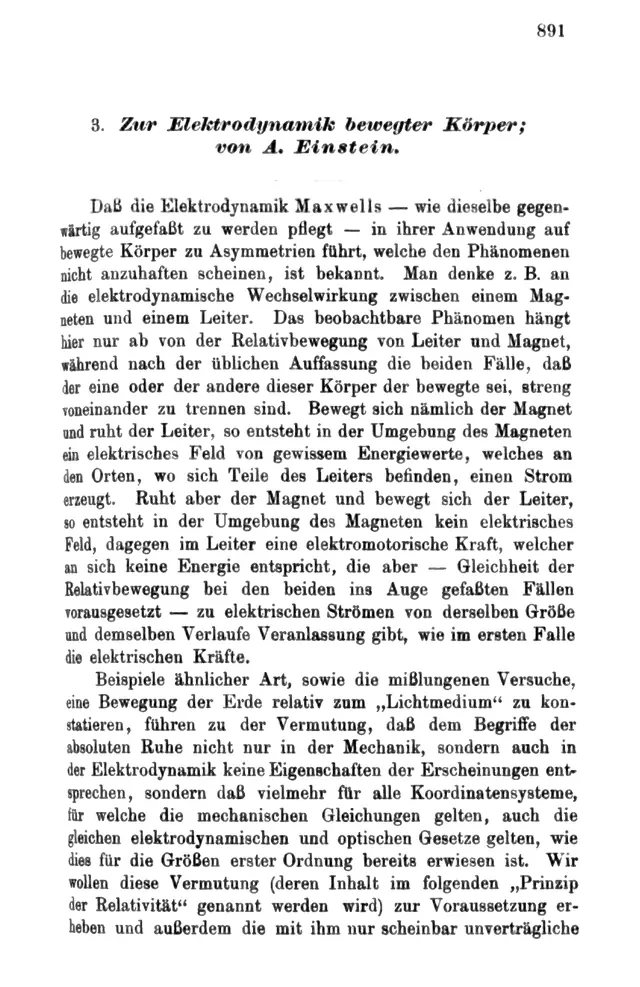
Zur Elektrodynamik bewegter Körper
Bern, Juni 1905.
Annalen der Physik (4) 17, 891–921 (1905).
[p. 892]I. Kinematischer Teil.
[p. 907]II. Eektrodynamischer Teil.
[p. 916]§ 9. Transformation der Maxwell-Hertzschen Gleichungen mit Berücksichtigung der Konvektionsströme.
[p. 916]Wir gehen aus von den Gleichungen:Speed of lightCharge velocity (stationary system)Charge density, stationary systemElectric field, stationary systemTime in the stationary systemMagnetic field, stationary systemPosition in the stationary systemMagnetic field, stationary systemPosition in the stationary systemMagnetic field, stationary systemElectric field, stationary systemElectric field, stationary systemCharge velocity (stationary system)Position in the stationary systemCharge velocity (stationary system)Explain this equation wobeiCharge density, stationary systemElectric field, stationary systemPosition in the stationary systemElectric field, stationary systemPosition in the stationary systemElectric field, stationary systemPosition in the stationary systemExplain this equation die -fache Dichte der Elektrizität und den Geschwindigkeitsvektor der Elektrizität bedeutet. Denkt man sich die elektrischen Massen unveränderlich an kleine, starre Körper (Ionen, Elektronen) gebunden, so sind diese Gleichungen die elektromagnetische Grundlage der Lorentzschen Elektrodynamik und Optik bewegter Körper.
Explained in Neutrality and current belong to a frame
[pp. 916–917]Transformiert man diese Gleichungen, welche im System gelten mögen, mit Hilfe der Transformationsgleichungen von § 3 und § 6 auf das System , so erhält man die Gleichungen:Speed of lightCharge velocity (moving system)Charge density, moving systemElectric field, moving systemTime in the moving systemMagnetic field, moving systemPosition in the moving systemMagnetic field, moving systemPosition in the moving systemMagnetic field, moving systemElectric field, moving systemElectric field, moving systemCharge velocity (moving system)Position in the moving systemCharge velocity (moving system)Explain this equationSo printed. Read: (1/V) dL'/dτ = dY'/dζ - dZ'/dη , (1/V) dM'/dτ = dZ'/dξ - dX'/dζ , (1/V) dN'/dτ = dX'/dη - dY'/dξ. In the transformed system of section 9, the three right-hand equations (the magnetic ones) are printed without the factor 1/V before the time derivative. The record in the correction log wobeiCharge velocity (stationary system)Speed of the moving systemSpeed of lightCharge velocity (moving system)Charge velocity (stationary system)Lorentz factorCharge velocity (moving system)Charge density, moving systemElectric field, moving systemPosition in the moving systemElectric field, moving systemPosition in the moving systemElectric field, moving systemPosition in the moving systemCharge density, stationary systemCharge velocity (stationary system)Charge velocity (moving system)Explain this equation Da — wie aus dem Additionstheorem der Geschwindigkeiten (§ 5) folgt — der Vektor nichts anderes ist als die Geschwindigkeit der elektrischen Massen im System gemessen, so ist damit gezeigt, daß unter Zugrundelegung unserer kinematischen Prinzipien die elektrodynamische Grundlage der Lorentzschen Theorie der Elektrodynamik bewegter Körper dem Relativitätsprinzip entspricht.
Explained in Neutrality and current belong to a frame
[p. 917]Es möge noch kurz bemerkt werden, daß aus den entwickelten Gleichungen leicht der folgende wichtige Satz gefolgert werden kann: Bewegt sich ein elektrisch geladener Körper beliebig im Raume und ändert sich hierbei seine Ladung nicht, von einem mit dem Körper bewegten Koordinatensystem aus betrachtet, so bleibt seine Ladung auch — von dem „ruhenden“ System aus betrachtet — konstant.
Explained in Neutrality and current belong to a frame