A derivation, to an approximation
Why viscosity changes the spread
What fixes D for a small spherical tracer in a liquid?
The 9 printed paragraphs this passage explains
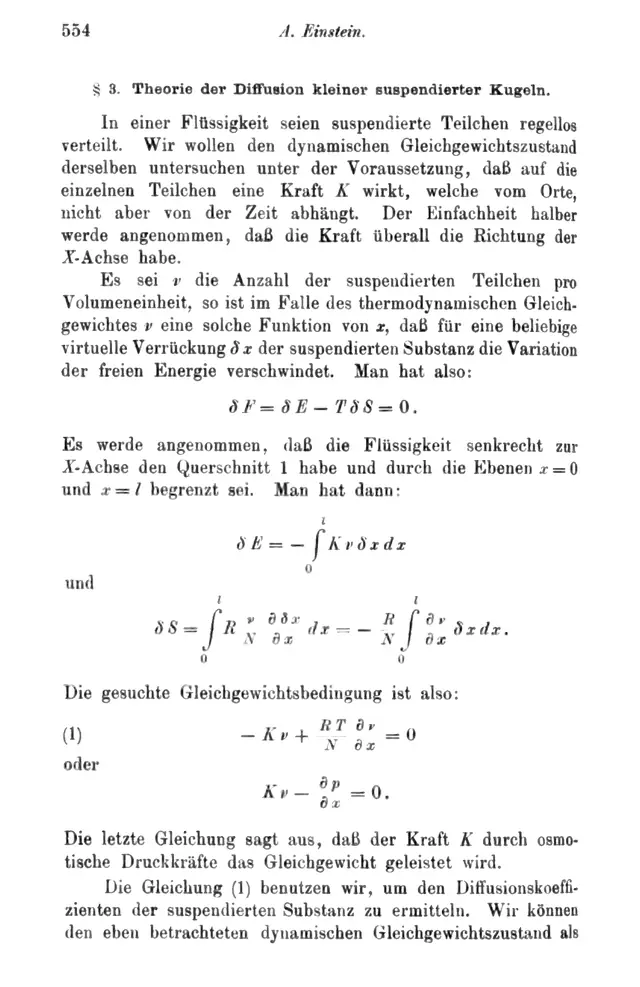
- §3, paragraph 1: Suspended particles are spread irregularly through a liquid, and each is acted on by a force K that depends on position but not on time; for simplicity the force points along the X axis everywhere.
- §3, paragraph 2: In equilibrium the number of particles per unit volume varies along x so that the free energy does not change under any small virtual displacement; working out the energy and entropy changes gives equation (1), in which the force K is held in balance by osmotic pressure. The passage that explains §3 states this balance directly; it does not follow Einstein's route through the variation of the free energy.
- §3, paragraph 3: Einstein uses equation (1) to find the diffusion coefficient, reading the equilibrium as two opposed processes: the particles drifting under the force K, and diffusion driven by their irregular thermal motion.
- §3, paragraph 4: For spheres of radius P in a liquid of viscosity k, the force K gives each particle the speed K divided by 6πkP, so that many particles times that speed cross unit area in unit time.
- §3, footnote 1: The footnote refers to Kirchhoff's lectures on mechanics, lecture 26, section 4, for the drag on a sphere moving slowly through a liquid.
- §3, paragraph 5: With D the diffusion coefficient, diffusion carries particles across unit area at a rate D times the fall of their number per unit volume along x; in dynamic equilibrium the drift and the diffusion cancel, which is equation (2).
- §3, paragraph 6: Equations (1) and (2) together give D as RT/N divided by 6πkP: apart from universal constants and the absolute temperature, the diffusion coefficient depends only on the liquid's viscosity and the size of the particles.
- §5, paragraph 1: Combining the diffusion coefficient found in §3 for small spheres of radius P with the displacement law of §4 and eliminating D gives λx in terms of the time, the temperature, the viscosity k and the radius P.
- §5, paragraph 2: Taking N as 6 · 10²³ from the kinetic theory of gases, water at 17 °C as the liquid, and particles 0.001 mm across, λx for one second comes to 8 · 10⁻⁵ cm, or 0.8 micron, and about 6 microns in one minute.
For small spheres in a liquid, a more viscous liquid gives a smaller : doubling the viscosity halves the mean square at a fixed time and divides the RMS displacement by , not by 2.
The displacement law tells us what a given predicts. A separate model connects to a tracer’s physical surroundings. Let be mobility, so a small force produces mean drift . Stokes drag for a sphere gives .
Open the foundation: Viscosity and Stokes drag
Let be number density. At isothermal balance the force density balances the osmotic-pressure gradient. With ideal osmotic pressure , the drift flux becomes times the density gradient. Equating it with the opposite diffusive flux gives .
Open the foundation: Osmotic pressure and free energy
Stokes–Einstein diffusivity is the gas constant times temperature, divided by six pi times viscosity times radius times Avogadro's number; equivalently, Boltzmann's constant times temperature, divided by six pi times viscosity times radius.
The equality kB = R/N relates the two forms. For a prediction using modern constants it is convenient. For an inference of N, using a value of kB derived from that same N would defeat the point.
Show every step here: Why viscosity changes the spread
- Name the quantities. is the absolute temperature, in kelvin. is the liquid’s dynamic viscosity, its resistance to flow, in pascal seconds. is the radius of the spherical tracer. is the molar gas constant, and is the number of molecules in a mole. Einstein prints the viscosity as and the radius as ; his is the viscosity, not Boltzmann’s constant.
- is the diffusivity of the earlier passages: it says how fast the mean square grows, . This passage asks what fixes . The route has two halves: how a tracer answers a steady push, and how the crowding of many tracers pushes back.
- First half, the push. Suppose a small steady force acts on each tracer. In a viscous liquid the tracer soon moves at a steady mean drift speed in proportion to the force. Call the ratio of speed to force the mobility , so the drift speed is .
- Stokes’s law gives the drag on a sphere moving slowly at speed through a liquid as . At steady drift the drag balances the push, , so and the mobility is . Stokes’s law is brought in from the theory of fluids; the random-walk argument does not supply it.
- Second half, the crowding. Let be the number of tracers per unit volume, which Einstein writes . Few, small tracers in a liquid exert an osmotic pressure, written here Π, of the same form as an ideal gas’s pressure: Π = cRT/N. Dividing by turns the gas constant per mole into a constant per molecule.
- Let the density vary along . A gradient is the rate at which a quantity changes with position. With held fixed, only varies in cRT/N, so the constant factor comes outside: the gradient of Π is times the gradient of .
- In a steady balance, the force on the tracers in a thin slab is held by the difference in osmotic pressure across it. Per unit volume that reads: equals the gradient of Π, which is times the gradient of . This osmotic law, like Stokes’s, is brought in from outside; conservation of tracers alone does not give it.
- Now count flows. A flux is the number of tracers crossing unit area in unit time. Tracers drifting at speed with density carry the drift flux . Multiply the balance of the last step by : the drift flux is times the gradient of .
- Fick’s law gives the diffusive flux: tracers spread from crowded to sparse regions, and the flux is times the gradient of , with the minus sign because the flow runs down the gradient.
- In the balance nothing flows overall, so the two fluxes add to zero: times the gradient, minus times the gradient, is zero. Divide by the gradient, which is not zero where the density varies: .
- Substitute the Stokes mobility : , which is divided by . Einstein found this in §3 and quotes it at the start of §5 as , with his for and his for .
- Boltzmann’s constant equals , the gas constant per molecule. Replacing by gives the second form. Both are one relation:
Stokes–Einstein diffusivity is the gas constant times temperature, divided by six pi times viscosity times radius times Avogadro's number; equivalently, Boltzmann's constant times temperature, divided by six pi times viscosity times radius.
- Which form to use depends on the question. To predict a spread from modern constants, the form is convenient. To infer from a spread, it defeats the point: a value of derived from a known would put the answer into the data. The form keeps separate, because can be measured on gases without counting molecules.
- Einstein’s own numbers, from §5: water at 17 °C, so = 290.15 K; the viscosity printed as = , a bare number that in the centimetre-gram-second units of the time means poise, and is Pa·s; a particle diameter printed as 0,001 mm, so = 0.0005 mm = m; and = from the kinetic theory of gases. The paper does not print ; this edition supplies = 8.31 J/(mol·K).
- The denominator: 6π × ( Pa·s) × ( m) = kg/s. The numerator: = 8.31 × 290.15 / () = J. Their quotient is = , since a joule divided by a kilogram per second is a square metre per second.
- With from §4: at = 1 s the mean square is = , whose square root is m, about 0.8 μm. Einstein prints “ cm = 0,8 Mikron”. At = 60 s the mean square is 60 times larger, so is , about 7.75, times larger: 6.16 μm, which Einstein gives as about 6 micrometres in one minute.
- Now double the viscosity, holding , and the constants fixed. sits in the denominator, so halves, to , and the mean square at a fixed time halves with it. The RMS is a square root, so it changes by a factor , about 0.707: at 1 s it falls from 0.795 μm to 0.562 μm. Doubling the viscosity divides the RMS displacement by , not by two.
Explore the equations in this step
Read each operation, check its units and assumptions, or open the mathematical step behind it. These are modern teaching equations, not the equations as printed.
Explore the equation · Modern model notationEinstein's letters
The same diffusivity, written with the gas constant
is times over six pi times , and .
is times over six pi times , and .
Select a term or operation. In the formula, Down enters an operation, Up returns to its parent, and Left/Right move between siblings. Escape clears selection. Tab leaves the formula.
Each term and operation, in words
No live values
This equation states a relation. No instrument on this page computes its terms.
Read the equation aloud in words
D equals R T over six pi eta a N sub A.
Einstein's form: the gas constant per molecule, R over N, stands where the modern form writes Boltzmann's constant. A larger N would make each molecule's kick smaller and the spreading slower.
Model assumptions and every term’s meaning
- A dilute suspension of spheres, each moving slowly through a Newtonian liquid (Stokes drag).
- Avogadro's number is the quantity the paper sets out to measure.
- These are modern teaching equations in SI notation, not a transcription of the printed paper. The paper writes k for the viscosity.
- Six pi eta a N sub A
- Stokes's drag coefficient for one sphere, times Avogadro's number. Read the prerequisite
- R times T
- Thermal energy per mole. Read the prerequisite
- Thermal energy over drag
- Kicks drive spreading; drag resists it. Read the prerequisite
- What it asserts
- The spreading rate is fixed by temperature, viscosity, size and the number of molecules in a mole. Read the prerequisite
- Avogadro's number
- Molecules per mole: what the measurement is meant to find. Read the prerequisite
- Diffusion coefficient
- How fast the mean square displacement grows: half its rate of growth. Not a speed. Read the prerequisite
- Gas constant
- Energy per mole per kelvin. Read the prerequisite
- Particle radius
- The radius of the suspended sphere, not its diameter. Read the prerequisite
- Absolute temperature
- Temperature in kelvin. Read the prerequisite
- Viscosity
- The liquid's resistance to shear. The paper writes it k, which is not Boltzmann's constant. Read the prerequisite
Every term’s units were checked when this page was built. That checks the units, not the model. This equation is written for this edition in modern notation, not transcribed from the paper.
Explore the equation · Modern model notation
Resistance to motion controls spreading
Shown in modern letters; Einstein's are in §3 of the German source face.
is thermal energy divided by the viscous drag coefficient.
Select a term or operation. In the formula, Down enters an operation, Up returns to its parent, and Left/Right move between siblings. Escape clears selection. Tab leaves the formula.
Each term and operation, in words
No live values
Symbolic here. Open the linked laboratory for a worked example and live values.
Read the equation aloud in words
The diffusion coefficient equals the Boltzmann constant times the absolute temperature, divided by six times pi times the dynamic viscosity times the particle radius.
Thermal energy competes with viscous drag. Doubling viscosity halves the diffusion coefficient while reducing RMS displacement only by the square root of two. Radius means radius, not diameter.
Model assumptions and every term’s meaning
- Dilute, approximately spherical tracers with no-slip Stokes drag in a homogeneous Newtonian liquid.
- Wall corrections, interactions, inertia, and observation noise are not included.
- The modern SI 2019 constant set is used; this is not a historical inversion exercise.
- An ideal model
- This equation assumes the dilute spherical tracer and Stokes-drag model; dimensional consistency alone does not establish those assumptions. Read the prerequisite
- Diffusion coefficient
- A squared-distance-per-time coefficient. This value comes from the accepted model calculation. Read the prerequisite
- Why divide by drag?
- Increasing the denominator reduces diffusivity at fixed thermal energy. This is a model dependence, not a rule that every larger quantity must reduce motion. Read the prerequisite
- Thermal energy scale
- Boltzmann constant times absolute temperature supplies energy per particle. Read the prerequisite
- A known modern constant
- The SI 2019 constant set supplies this value. It must not be treated as independent historical evidence when trying to infer molecular number. Read the prerequisite
- Absolute temperature
- Use kelvin. The laboratory holds viscosity as an independently supplied parameter. Read the prerequisite
- The drag coefficient
- Six pi times viscosity times radius is Stokes drag per speed for an isolated sphere in the assumed low-Reynolds regime. Read the prerequisite
- Dynamic viscosity
- Viscosity is in the denominator. Doubling it at fixed temperature and radius halves D, not the RMS displacement. Read the prerequisite
- Particle radius
- The input is a radius, not a diameter. Confusing them changes the predicted coefficient by a factor of two. Read the prerequisite
Every term’s units were checked when this page was built. That checks the units, not the model. This equation is written for this edition in modern notation, not transcribed from the paper.
Modern qualifications
Einstein reaches this relation in §§2–3 through osmotic pressure and Stokes’s law, writing for the viscosity and for the radius: . His is not Boltzmann’s constant. William Sutherland published the same relation independently in 1905, and Marian Smoluchowski reached the displacement law by another route in 1906. The laboratories use modern SI constants and say so.
Combining ideal osmotic pressure with mobility and diffusive balance relates diffusivity to temperature, viscosity and radius.
What this relies on
- Few, small, spherical particles in a uniform liquid, with Stokes’s drag and ideal osmotic pressure.
- R, the gas constant, is known separately; N is the number of molecules in a mole.
Assumptions and limits: Why viscosity changes the spread
Assumed here
- Few, small, spherical particles in a uniform liquid, with Stokes’s drag and ideal osmotic pressure.
- R, the gas constant, is known separately; N is the number of molecules in a mole.
What this does not establish
- Slip at the particle’s surface, its inertia, interactions between particles, unusual liquids, and gases are all left out.
- Stokes’s law and the osmotic-pressure law are brought in from outside; conservation alone does not give them.
Earlier step: What the spreading curve predicts
Source context: Annalen der Physik (4), 17, 549–560 (1905), §§1–5. Bibliographic pointer; this preview is not a source transcription or translation.