A derivation, to an approximation
What would let us count molecules?
Which additional measurements turn displacement into an estimate of N?
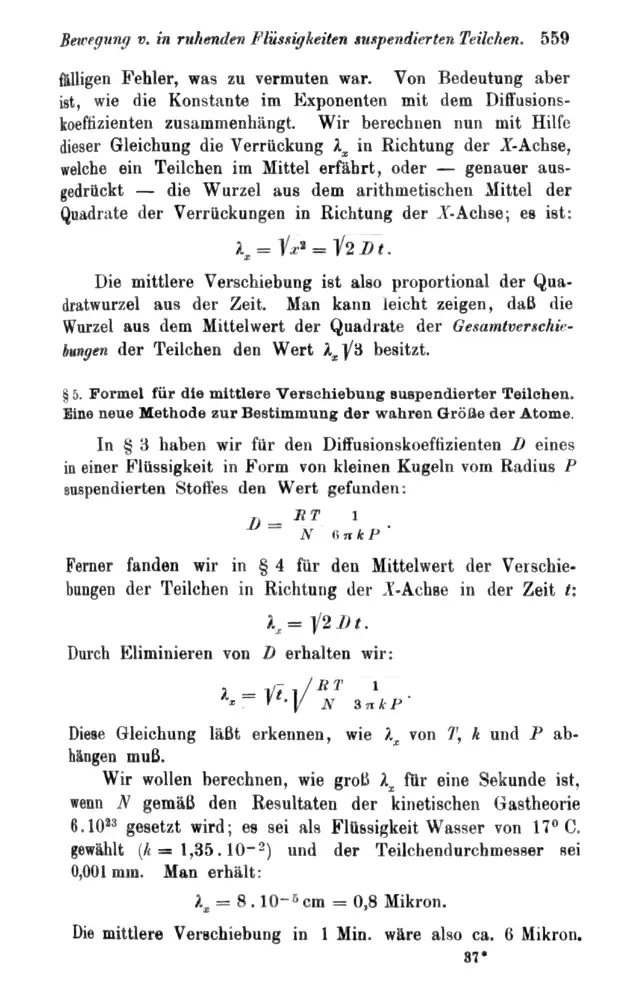
The 3 printed paragraphs this passage explains
- §5, paragraph 2: Taking N as 6 · 10²³ from the kinetic theory of gases, water at 17 °C as the liquid, and particles 0.001 mm across, λx for one second comes to 8 · 10⁻⁵ cm, or 0.8 micron, and about 6 microns in one minute.
- §5, paragraph 3: Turned around, the same relation can be used to determine N from observed displacements.
- §5, paragraph 4: Einstein closes by hoping that a researcher will soon succeed in deciding the question raised here, which he calls important for the theory of heat.
Measured displacements give . Turning into a count of molecules also needs the temperature, the viscosity and, above all, an independently measured radius. A simulation that assumes the answer cannot measure it.
Diffusivity is the mean-square displacement divided by twice the time; the molecular number is the gas constant times temperature times time, divided by three pi times viscosity times radius times the mean-square displacement.
The first expression refers to the model mean square, or to an estimate obtained from an appropriate sample. The second is an inversion under the stated physical assumptions. An estimate needs uncertainty and checks of those assumptions; rearranging symbols does not remove experimental error.
Without an independent radius, the same D can result from many pairs of a and N. The data then select a compatible family rather than a unique molecular number. The existing synthetic laboratories explore this relationship but do not supply a historical measurement.
Open the foundation: Two measurements, two unknowns
Open the foundation: Mean, variance and RMS
Show every step here: What would let us count molecules?
- Start from the displacement law of §4, . Here is the mean-square displacement along one axis after an observation time , and is the tracers’ diffusivity. Divide both sides by , which is allowed for any positive : .
- Next, the physical relation of the previous passage, , where is the gas constant, the absolute temperature, the viscosity (Einstein’s ), the tracer radius (his ) and the number of molecules in a mole.
- Solve it for . Multiply both sides by , giving . Then divide both sides by : .
- Put the first result in for . Dividing by a fraction is multiplying by its inverse, so dividing by multiplies by : .
- The 2 above and the 6 below leave a 3 below, since 2/6 = 1/3. Einstein prints this inversion at the end of §5 as , with for the mean square, his for and his for . The two results together:
Diffusivity is the mean-square displacement divided by twice the time; the molecular number is the gas constant times temperature times time, divided by three pi times viscosity times radius times the mean-square displacement.
- Read what each symbol needs. In the formula is the model’s mean square. From a finite set of tracked particles you get an estimate of it, and that estimate has an uncertainty the formula does not show. Rearranging the symbols carries that uncertainty into ; it does not remove it.
- , , and must each be measured separately, and all in one system of units. The inversion also holds only under the assumptions that gave : few, small spheres in a liquid, Stokes’s drag and ideal osmotic pressure. An estimate needs checks of those assumptions as well as its uncertainty.
- The radius matters most. In , and appear only as the product . A measured fixes that product, , and nothing more: halve and double , and is unchanged. Without an independent radius, the data select a family of compatible pairs rather than one molecular number.
- Run Einstein’s §5 case through the formulas. His inputs are = 290.15 K (water at 17 °C), = Pa·s, = m and = , with = 8.31 J/(mol·K) supplied by this edition. The previous passage found = from them, so at = 1 s the mean square is , an RMS of 0.795 μm.
- Now invert. = 8.31 × 290.15 × 1 = 2411 J·s/mol. = 3π × () × () × () = J·s. Their quotient is = per mole: the that went in.
- That checks the arithmetic of the inversion and nothing else. It cannot count molecules, because the mean square fed into it was computed from an assumed . In §5 Einstein ran the relation forward in this way, as a prediction, and printed the inversion for a future measurement to use; he did not estimate himself.
- The same numbers show the family. With this , the product is metres per mole. A radius of 0.5 μm gives = ; had the radius been 1 μm, the same would give = . Only an independent measurement of chooses between them.
- A simulation that uses an assumed molecular number can test this inversion’s arithmetic in the same way, but cannot independently establish that number in nature.
Explore the equations in this step
Read each operation, check its units and assumptions, or open the mathematical step behind it. These are modern teaching equations, not the equations as printed.
Explore the equation · Modern model notation
From a measured spread to the number of molecules
Shown in modern letters; Einstein's are in §5 of the German source face.
is times times over three pi times , and the mean of squared.
Select a term or operation. In the formula, Down enters an operation, Up returns to its parent, and Left/Right move between siblings. Escape clears selection. Tab leaves the formula.
Each term and operation, in words
No live values
This equation states a relation. No instrument on this page computes its terms.
Read the equation aloud in words
Avogadro's number N equals the gas constant times the temperature times the observation time, divided by the product of three pi, the viscosity, the particle radius and the mean square displacement.
With temperature, viscosity and radius measured independently, the observed mean square gives Avogadro's number. The radius has to come from somewhere else: the spread alone cannot separate it from N.
Model assumptions and every term’s meaning
- Radius, viscosity and temperature are measured independently of the displacement data.
- The same dilute-sphere model as the diffusivity.
- These are modern teaching equations in SI notation, not a transcription of the printed paper. The paper writes k for the viscosity.
- Three pi eta a times the mean square
- Drag and the observed spread. Read the prerequisite
- The observed mean square
- From many displacements. Read the prerequisite
- R T t
- Thermal energy per mole, times the interval. Read the prerequisite
- The ratio
- Per mole. Read the prerequisite
- What it asserts
- Counting molecules becomes a measurement of spreading. Read the prerequisite
- x squared
- Each observed displacement, squared. Read the prerequisite
- Displacement since the start
- How far one particle has moved along x since observation began. Read the prerequisite
- Estimated Avogadro number
- The number of molecules per mole this measurement infers. An estimate, not the defined constant. Read the prerequisite
- Gas constant
- Energy per mole per kelvin. Read the prerequisite
- Particle radius
- The radius of the suspended sphere, not its diameter. Read the prerequisite
- Absolute temperature
- Temperature in kelvin. Read the prerequisite
- Observation interval
- The time over which displacement is observed. Read the prerequisite
- Viscosity
- The liquid's resistance to shear. The paper writes it k, which is not Boltzmann's constant. Read the prerequisite
Every term’s units were checked when this page was built. That checks the units, not the model. This equation is written for this edition in modern notation, not transcribed from the paper.
Explore the equation · Modern model notation
Read D off the observations
Shown in modern letters; Einstein's are in §5 of the German source face.
is the mean of squared over two .
Select a term or operation. In the formula, Down enters an operation, Up returns to its parent, and Left/Right move between siblings. Escape clears selection. Tab leaves the formula.
Each term and operation, in words
No live values
This equation states a relation. No instrument on this page computes its terms.
Read the equation aloud in words
D equals the mean square displacement over two t.
Turn the relation around: a measured mean square over a known interval gives D.
Model assumptions and every term’s meaning
- The mean square is estimated from many observed displacements over one interval t.
- These are modern teaching equations in SI notation, not a transcription of the printed paper.
- Two t
- Twice the interval. Read the prerequisite
- Their mean
- An estimate from a finite sample. Read the prerequisite
- Mean square over two t
- Metres squared per second. Read the prerequisite
- What it asserts
- D is measurable from displacements alone. Read the prerequisite
- x squared
- Each observed displacement, squared. Read the prerequisite
- Diffusion coefficient
- How fast the mean square displacement grows: half its rate of growth. Not a speed. Read the prerequisite
- Displacement since the start
- How far one particle has moved along x since observation began. Read the prerequisite
- Observation interval
- The time over which displacement is observed. Read the prerequisite
Every term’s units were checked when this page was built. That checks the units, not the model. This equation is written for this edition in modern notation, not transcribed from the paper.
Modern qualifications
Einstein did not estimate . He took from the kinetic theory of gases and predicted a displacement of about 0.8 μm in one second for particles 0.001 mm across in water at 17 °C, closing with the hope that someone would soon test it. Jean Perrin’s measurements from 1908 onward did, and gave values of near . This page supplies no dataset of its own.
Displacement constrains diffusivity; independent radius, viscosity, temperature and gas-constant information are needed to infer molecular number.
What this relies on
- A measured mean-square displacement along one axis, or how fast it grows with time.
- Separately measured R, T, η and particle radius a, for few small spheres in a liquid.
Assumptions and limits: What would let us count molecules?
Assumed here
- A measured mean-square displacement along one axis, or how fast it grows with time.
- Separately measured R, T, η and particle radius a, for few small spheres in a liquid.
What this does not establish
- A synthetic run generated from an assumed N is not independent evidence for N.
- Without the radius, the diffusivity fixes only the product aN.
- Measurement noise, drift, exposure and finite sampling require separate treatment.
Earlier step: Why viscosity changes the spread
Source context: Annalen der Physik (4), 17, 549–560 (1905), §§1–5. Bibliographic pointer; this preview is not a source transcription or translation.